Green Screen Studio vs Location Filming Compared
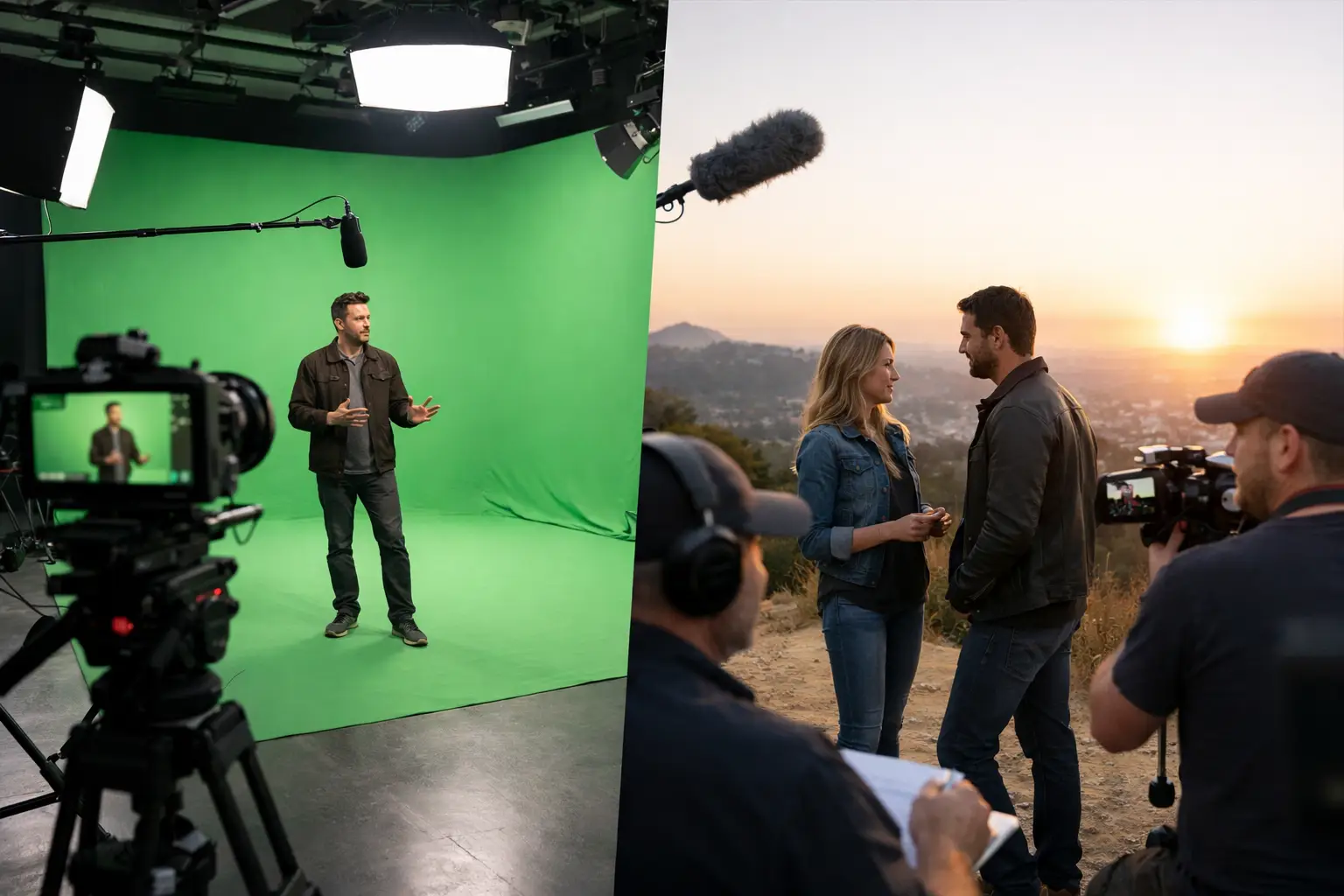
Table of Contents
ToggleA client wants a car on a coastal road at sunrise, a product launch inside a futuristic space, or a presenter in a city skyline. The creative question is often framed as green screen studio vs location filming, but the commercial decision sits underneath it: where can you deliver the strongest images with the least risk to time, budget and crew?
Neither route is automatically better. A location can provide texture that would be expensive to recreate, while a green screen studio gives production control that even the best location cannot match. The right choice depends on what must be real in camera, what can be built later, and how much uncertainty the schedule can tolerate.
Green Screen Studio vs Location Filming: The Real Difference
Location filming captures a genuine environment. Its architecture, daylight, weather, surrounding sound and incidental detail can give a campaign or film a quality that audiences recognise immediately. If the setting is central to the story – an actual restaurant, a recognisable street or a working industrial site – filming there may be the most convincing option.
A green screen studio replaces the environment with controlled space. Performers, products, vehicles or props are filmed against an evenly lit green background, allowing the final setting to be added in post-production. That background might be a CG world, a supplied plate, a virtual environment or footage shot elsewhere.
The practical difference is control. On location, the production adapts to the environment. In a studio, the environment adapts to the production. For commercials, branded content and repeatable social assets, that distinction can determine whether a shoot stays on schedule.
When Location Filming Earns Its Cost
Location work is at its best when physical reality adds value that cannot be faked cheaply. A heritage interior with aged surfaces, a busy kitchen in service, or a particular London exterior can bring depth, scale and natural behaviour to a frame. Actors also tend to respond well to a real setting, particularly where movement through the space is part of the performance.
It can be more efficient where the location needs very little alteration. If a brand needs a chef preparing food in a functioning restaurant and the venue already has the right look, forcing that scene into a studio could create unnecessary art department and post-production work.
However, a location fee is rarely the full cost. Permissions, recce days, travel, unit vehicles, parking restrictions, security, location management, neighbour liaison, power distribution, wet-weather cover and limited shooting hours all need to be priced. In London, access can become the production problem before the camera is even built.
Daylight is another variable. It may look perfect during a recce, then change completely on the shoot day. Windows introduce continuity challenges, weather can disrupt the schedule, and exterior sound often means pauses for aircraft, traffic, deliveries or nearby works. A location may be visually right but operationally wrong for a tight call sheet.
Location filming suits shoots where
Location is usually the stronger choice when the authentic setting is a key creative asset, the script benefits from practical interaction with the space, and the schedule has room for real-world variables. It is also sensible when the required visual effects work would be substantial enough to outweigh the savings made on location logistics.
The crucial point is to assess the whole production day, not just the hire rate. A low-cost venue with poor load-in, no parking and a hard finish can cost more than a better-equipped studio once crew time and contingency are included.
Why Green Screen Gives Productions More Control
Green screen is not simply a cost-saving substitute for a location. Used properly, it is a production method that separates the performance, product or action from the final environment. That allows the team to protect the elements that need precision.
In a controlled studio, lighting can remain consistent from the first take to the last. There is no loss of daylight, no rain cover decision, no public footfall and no unexpected sound interruption. This matters for presenter-led content, fashion, product demonstrations, music videos and campaign shoots that need multiple deliverables from one setup.
A studio also makes repeated shooting practical. A brand can capture a hero film, cut-downs, stills, vertical assets and alternate messaging without relocating the crew. If the background needs to change from a city roof to a tropical landscape, the subject setup can remain largely intact while post-production handles the environment.
For vehicle work, larger studios with drive-in access can remove a major logistical barrier. Bringing a vehicle straight onto the stage is more efficient than negotiating a constrained location entrance or shooting outdoors around public access. The same applies to large props, set pieces and equipment arriving by van or lorry.
At Cineview Studios, the combination of a large production floor, high ceilings, lighting grid, ground-floor shutter access and in-house lighting and grip supports this kind of controlled workflow. The benefit is not just more space. It is more usable time on the shoot day.
The Green Screen Trade-Off: Post Must Be Planned Early
Green screen is powerful, but it is not a shortcut for poor planning. A convincing composite depends on clean keying, appropriate lighting, accurate camera tracking where needed, realistic shadows and a background designed for the shot. If the final world is ambitious, visual effects costs can become significant.
Hair, translucent fabrics, reflective products, smoke, glass and motion blur all require careful consideration. Green spill can contaminate edges, especially around skin tones and shiny surfaces. A competent crew will manage this with subject separation, controlled exposure and deliberate lighting, but the setup needs time.
The background should also inform the shoot. If the final environment has low evening light, filming a brightly lit subject with hard overhead illumination will create a mismatch. Camera angle, lens choice, depth of field, eyeline and movement must be planned against the intended plate or CG scene.
This is why a pre-production conversation between director, cinematographer, production designer and post team is valuable. Agree what will be practical, what will be added, and what reference the crew needs on the day. Green screen works best when post-production is part of the shoot plan rather than an afterthought.
Cost: Compare Risk, Not Day Rates
The apparent price gap between studio and location filming can mislead. A studio day has a clear base cost, while a location may accumulate costs through staffing, transport, access restrictions and time lost to circumstances outside the production’s control. Conversely, a complex green screen scene may appear affordable until extensive CG, rotoscoping or compositing is added to the post budget.
For a simple presenter shoot against a designed digital setting, green screen often offers excellent value. The crew can complete a high volume of content in a controlled day, and the background can be localised or updated without another shoot. For a dramatic scene involving practical interaction with a detailed environment, filming at the right location may reduce post work and create a more natural result.
Build a comparison that includes the following production realities: location fees and permits, crew travel and overtime risk, power and access, art department requirements, weather contingency, studio equipment, pre-light time, visual effects scope and revision rounds. The cheapest option on paper is not always the least expensive route to an approved final asset.
Questions to Ask Before You Commit
Start with the final frame. Does the audience need to believe the subject is physically present in a real place, or does the setting exist mainly to support the message? Then consider whether that setting may change across markets, formats or campaign versions. If it might, a studio approach creates useful flexibility.
Next, test the operational plan. Can the location accommodate the crew, kit, client and talent comfortably? Is there reliable loading, parking, power and a quiet holding area? Can you pre-light, or will the team lose the first hours of the shoot to setup? These are practical questions, but they directly affect creative output.
Finally, look at the shot list. Wide shots with complex reflections, physical contact and natural environmental interaction may favour location filming. Controlled medium shots, product work, vehicle content, presenter pieces and high-volume campaign assets are often strong candidates for green screen.
The best decision is the one that protects the image and the schedule at the same time. Before booking, put one representative hero shot through both workflows with your director of photography and post team. The production route will usually become clear very quickly.
One thought on “Green Screen Studio vs Location Filming Compared”