Can Studios Accommodate Vehicle Shoots Properly?
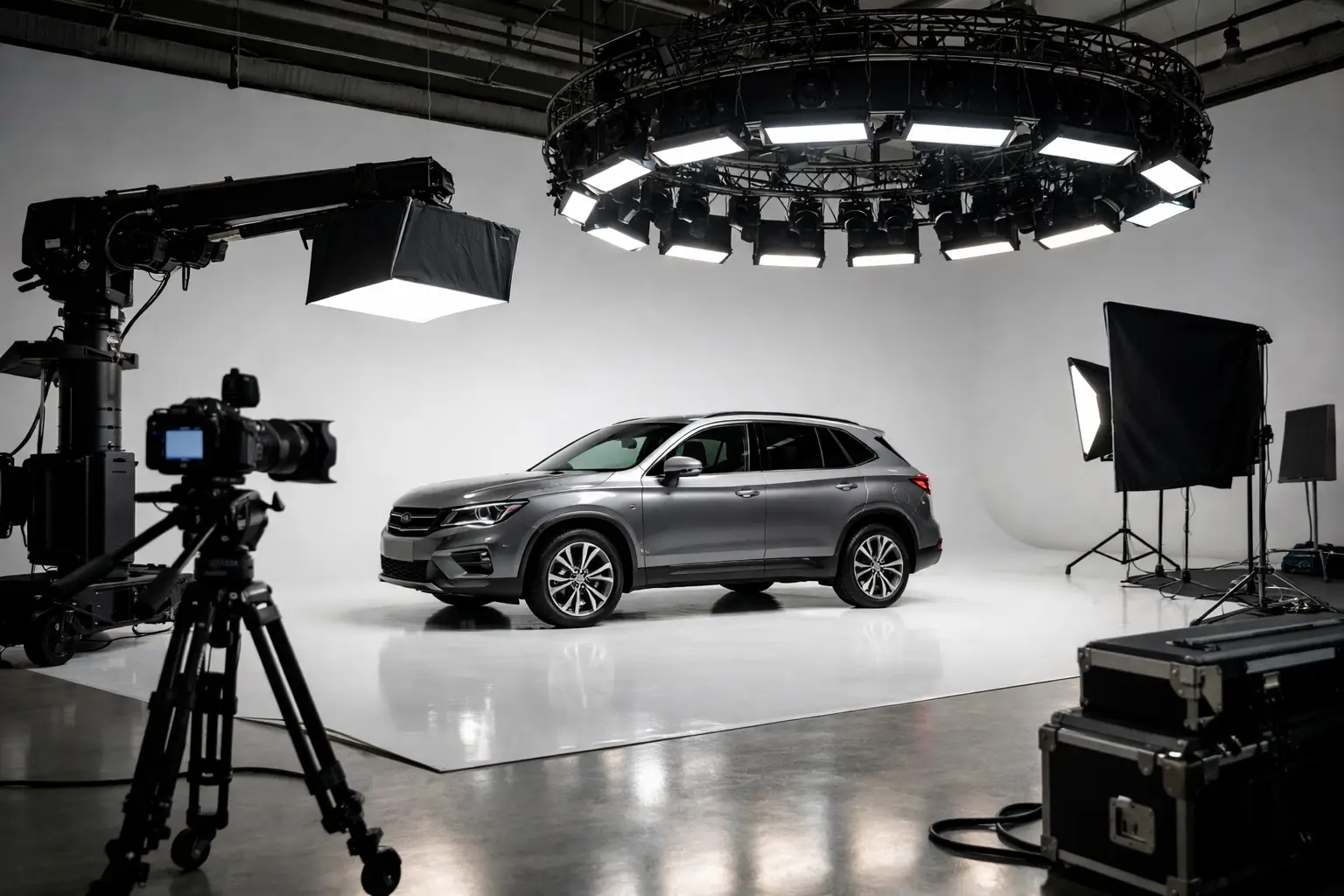
Table of Contents
ToggleA car does not become an easy studio prop just because it fits through the door. When clients ask, “can studios accommodate vehicle shoots?”, the real question is whether the space can support the entire production workflow: delivery, positioning, lighting, safety, client access and a clean exit at wrap.
For automotive campaigns, music videos, editorial work and branded content, the wrong studio creates expensive friction before the first frame is shot. A genuinely vehicle-ready facility gives the crew room to work around the vehicle, not merely somewhere to park it.
Can studios accommodate vehicle shoots without compromise?
Some can. Many cannot. London studios are often limited by narrow loading routes, upper-floor locations, low ceilings, restrictive building rules or access windows that work against a production schedule. A space advertised as “large” may still be unsuitable if a car cannot enter at ground level, turn safely or sit within the usable shooting area.
Vehicle shoots need a practical assessment rather than a simple yes or no. The key considerations are the vehicle’s dimensions and weight, shutter opening size, route from the road to the stage, floor loading, internal clearance and whether there is enough space for lighting, track, crew and client viewing.
A drive-in studio with ground-floor shutter access removes the most common obstacle. Instead of arranging difficult external offloads or relying on vehicle dollies, the car can be brought directly onto the set under controlled conditions. That saves time, reduces handling risk and gives the art department greater freedom over final positioning.
Access is the first production test
Before booking, establish the full access route. It is not enough to know that a studio has a large entrance. Production needs to know the shutter dimensions, height restrictions on approach roads, turning space, ramp gradients and whether delivery access is shared with other occupiers.
Ask whether the vehicle can be driven directly into the shooting space and whether loading is possible at the required time. A premium vehicle arriving on a low loader has different access needs from a compact car driven in by a picture vehicle supplier. Larger SUVs, vans and specialist vehicles may require wider clearances and more considered manoeuvring.
Free on-site parking also matters more than it first appears. Vehicle shoots bring crew cars, kit vans, catering, agency teams and sometimes more than one hero vehicle. If parking is distant or chargeable by the hour, budgets rise and the day loses momentum. Keeping vehicles, equipment and crew close to the stage makes call times, load-ins and changeovers easier to manage.
Space around the car is where the image is made
A vehicle may physically fit in a studio while still leaving no room to shoot it properly. Automotive work depends on controlled reflections, long lens positions, large modifiers, flags and negative fill. If the car is tight against a wall, the crew loses control over both the composition and the surface finish.
The most useful measurement is not only the studio footprint. It is the clear working area once the vehicle is in position. Can a camera operator move around the car? Can the lighting team place overhead fixtures and large frames at the correct distance? Can you create a clean profile shot without seeing unwanted walls, doors or equipment in the background?
High ceilings make a substantial difference. Cars are reflective objects, and low ceilings often appear in glass, paintwork and polished trim. A high lighting grid allows lights, silks and blackout materials to be rigged above the vehicle, helping crews shape reflections while keeping stands out of shot. It also creates more convincing scale for dramatic wide shots and moving camera work.
For brands, that extra room translates directly into stronger assets. You are not paying for empty floor space. You are buying creative options, faster lighting adjustments and fewer compromises in post-production.
Choose the background for the treatment, not the building
A vehicle shoot can require a crisp catalogue finish one day and a moody, high-contrast campaign look the next. The studio needs to support both without forcing the production into a visual treatment dictated by the room.
An infinity cove is ideal for clean automotive stills, launch content and e-commerce-led imagery where the vehicle needs to sit against an uninterrupted background. The scale of the cove matters: a shallow cove may work for close details but limit full-car angles, wide lenses and rear three-quarter shots.
A blackout stage offers better control where reflections, moving lights, projection or cinematic contrast are part of the brief. It lets the crew build darkness around the vehicle and introduce precisely the light needed for the shot. For music promos and commercials, this can be more efficient than attempting to fight daylight leakage in a conventional warehouse.
Green screen and virtual production capability open further options. Instead of taking an entire crew to multiple locations, a vehicle can be filmed in a controlled environment and placed into a digital setting. This is particularly useful for content requiring repeatable weather, night driving treatments, rapid market versions or visual worlds that would be difficult to access practically. It does, however, demand careful planning for reflections, plate photography and post-production integration. Virtual backgrounds are not a shortcut if the car’s surfaces have not been lit to match the final environment.
Safety and vehicle rules need to be agreed early
Bringing a vehicle inside changes the risk profile of the shoot. The studio and production team should agree the process before arrival, including who is authorised to drive, where the vehicle will be positioned and whether the engine needs to run indoors.
Combustion vehicles may be subject to restrictions around fuel levels, engine running, ventilation and fire safety. Electric vehicles have different considerations, including battery condition, charging arrangements and the vehicle’s weight. Classic cars can bring additional concerns around fluids, tyres and reliability. The right answer depends on the studio’s policies, the vehicle and the proposed activity, so this should be confirmed in writing rather than assumed from a previous shoot elsewhere.
Protecting the floor is also part of professional planning. Crews may need drip trays, wheel protection, track mats or carefully positioned boards, particularly for builds or long studio days. A tidy vehicle bay keeps the set safer and protects the finish of both the car and the studio.
Pre-rigging turns a vehicle day into a workable schedule
Automotive lighting takes time. The first setup often involves extensive reflection checks, fine adjustments to flags and large overhead sources, then repeated refinements once the camera angle is locked. Starting this process after the vehicle arrives is an inefficient use of a costly hire day.
A studio that permits pre-lighting and pre-rigging gives the gaffer, photographer or director of photography a head start. Fixtures can be hung, blackout can be installed and the initial set can be prepared before the hero vehicle enters. When the car arrives, the team can focus on its precise placement and finish rather than building the whole lighting plan from scratch.
In-house lighting and grip equipment can also reduce transport costs and simplify the call sheet. The value is not simply having lights available. It is having production-appropriate equipment already on site, with a team that understands where it can be rigged and how the room performs. For crews travelling light or working to a tighter budget, that can be the difference between a compromised setup and a properly executed one.
Build for the vehicle shoot you actually have
Not every project needs a full driving stage. A single static car on a clean background has very different requirements from a commercial involving rain effects, a fabricated garage, LED walls or multiple vehicle changes. Matching the studio to the brief prevents overspending on features you will not use, while avoiding the false economy of hiring a space that restricts the work.
For straightforward stills, prioritise drive-in access, ceiling height, a suitable cove and enough room for modifiers. For motion work, add sound considerations, blackout control, camera movement space and reliable power. For ambitious campaigns, look for set-build suitability, a strong lighting grid, flexible operating hours and support with production logistics.
Cineview Studios is designed around these practical requirements, combining ground-floor shutter access, high ceilings, production equipment and flexible working hours in a London facility built for more than a basic backdrop.
The best vehicle studio is not the one that promises the biggest floor area. It is the one that lets the vehicle arrive cleanly, lets the crew light it properly and leaves enough operational headroom for the idea to become the shot.
One thought on “Can Studios Accommodate Vehicle Shoots Properly?”