Studio Ceiling Height for Better Productions
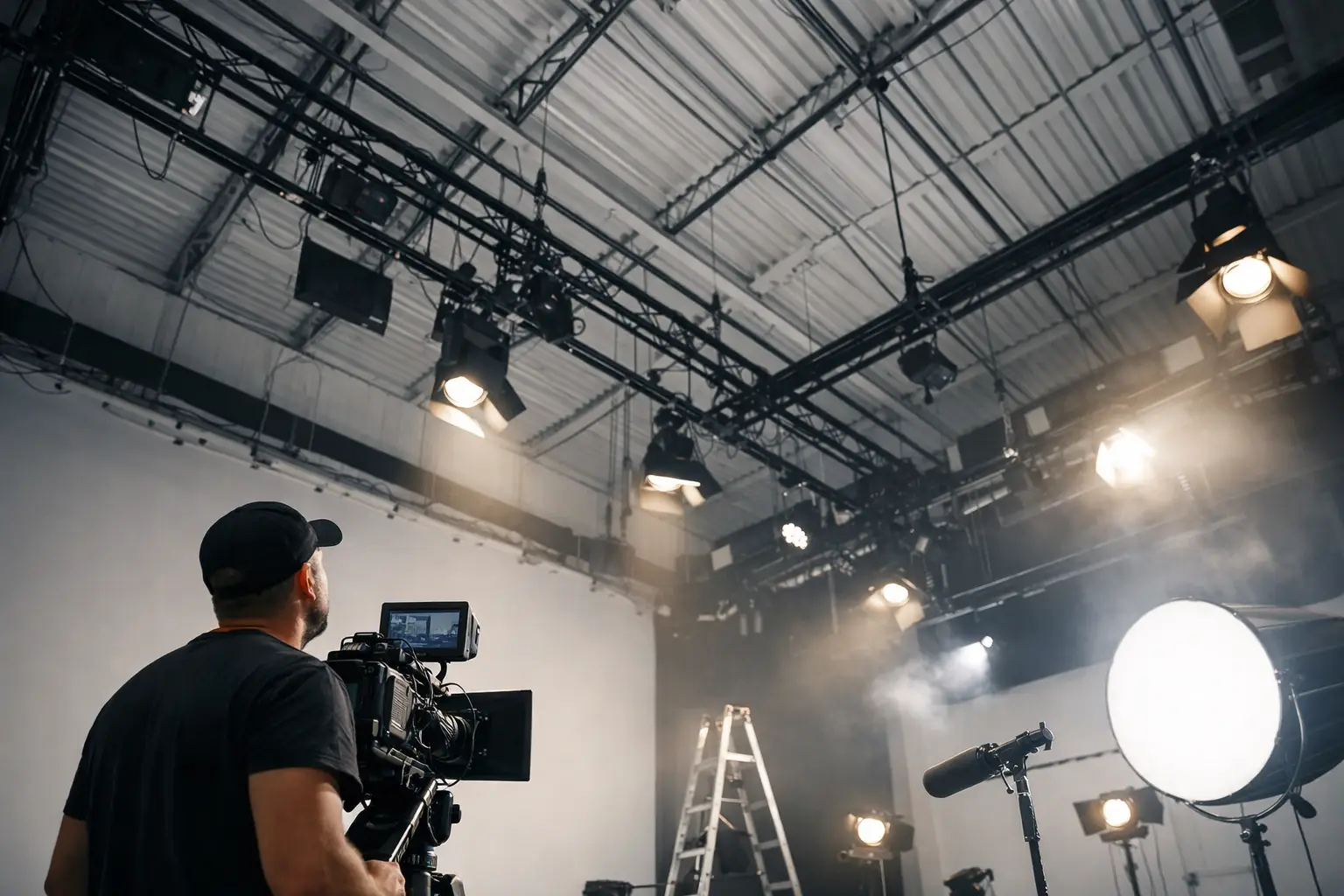
Table of Contents
ToggleA low ceiling rarely appears on a call sheet, but it can dictate the entire look and pace of a production. Studio ceiling height determines where lights can sit, how far talent can move from the background, whether a set can be built safely, and how much room the camera team has to work. For photo and film crews, it is not a cosmetic feature. It is production infrastructure.
In London, where many studio spaces have been adapted from offices, retail units or warehouses with restrictive overhead services, the difference becomes obvious as soon as the first stand goes up. A space may look generous in photographs, then feel compromised once flags, diffusion, boom arms, monitors and crew are in the room.
Why studio ceiling height changes the shoot
Ceiling height creates separation. With more vertical space, a gaffer can position a key light above the subject rather than firing it flat across the set. That makes it easier to shape faces, control shadows and keep stands out of frame. It also gives photographers more room to feather a large softbox or use overhead diffusion without placing the source uncomfortably close to talent.
For video, the benefit is just as practical. High-mounted fixtures can be kept above eyelines and camera angles, while a lighting grid allows the floor to stay clearer for tracks, operators, clients and art department. A clean floor is not a luxury on a commercial shoot. It reduces resets, makes movement safer and gives every department more usable working room.
Height also affects background control. When a subject is moved further from a cove, wall or green screen, lighting can be managed independently. You can light the background evenly while retaining shape and contrast on the subject. In a low room, that separation quickly disappears: fixtures compete for the same limited space, spill is harder to contain and the result can look flatter than intended.
How much ceiling height does a production need?
There is no single minimum that works for every shoot. A tabletop product job has very different requirements from a car commercial, fashion film or music video. The useful question is not simply, “How high is the ceiling?” It is, “How much clear working height remains once the grid, services and lights are accounted for?”
Portraits, e-commerce and packshots
A straightforward portrait or e-commerce shoot can often work in a lower space if the lighting brief is simple and the background is compact. But even here, extra height makes life easier. It allows a larger modifier to be placed above the subject, supports a cleaner top-down product setup and gives the crew options when the client asks for an alternative look halfway through the day.
For small products, height is especially useful when shooting overhead. A camera, rigging solution and lighting source all need space above the table. Without it, the camera angle narrows, reflections become harder to manage and the lighting becomes more frontal than the creative treatment intended.
Fashion, beauty and full-length work
Full-length fashion photography and beauty films benefit from genuine overhead clearance. The crew needs room for large soft sources, negative fill and flags while preserving distance between the model and backdrop. That distance helps create depth, keeps shadows off the background and makes a white cove or coloured set feel more polished on camera.
A lower room can still produce strong work, particularly with a controlled, close-framed concept. The trade-off is flexibility. If the brief moves from headshots to full-length movement, or from a hard-light treatment to a broad overhead source, the studio may become the limiting factor.
Commercial film, music videos and motion work
For motion shoots, ceiling height matters beyond the lighting plan. Camera cranes, jib arms, vertical movement and wide lenses all need clearance. So do practical set pieces, hanging props, large backdrops and lighting rigs that need to stay out of shot.
A higher studio gives directors and DOPs more freedom to build depth into a frame. Talent can move through the space rather than being held against a background. The camera can look upward without exposing unwanted ceiling detail. For dance, performance and action-led work, this can be the difference between adapting the idea and shooting it as conceived.
Set builds, vehicles and large-scale concepts
If a production involves flats, scenery, oversized props or a vehicle, vertical headroom should be considered at the same time as floor area and access. A set that fits on paper may become difficult to light once the roofline is close to the grid. Equally, a tall vehicle or large prop may require a clear loading route, ground-floor access and enough space to manoeuvre safely inside.
This is where a purpose-built production facility has a clear advantage over a visually appealing but restrictive location. The usable volume of the room matters more than the square footage alone.
Do not confuse ceiling height with usable height
Studios sometimes quote the height to the roof apex, which can sound impressive but may not reflect the height available to the crew. Ask for the clear height to the lowest obstruction, including beams, ventilation, cable trays, sprinklers and the lighting grid. If you intend to hang scenery or rig fixtures, ask what load-bearing points are available and whether pre-rigging is permitted.
It is also worth clarifying the cove dimensions separately. A tall room does not automatically mean a tall infinity cove, and a wide cove may have a different usable height depending on the curve and overhead rigging. For green screen, check whether the screen can be lit evenly from an appropriate distance and whether there is enough room to keep the subject clear of green spill.
A good studio team should be able to answer these questions directly before the booking. If the plan involves a specific crane, large frame, overhead camera rig or set build, provide dimensions early. This avoids turning a technical recce into a late production problem.
The lighting grid is where height becomes useful
High ceilings deliver the greatest value when the studio has a properly planned lighting grid. Without one, crews may still need to build a forest of stands, which consumes floor space and slows down every reset. With grid access, fixtures can be flown, angled precisely and kept safely above the working area.
That is particularly valuable for multi-set days, interviews, virtual production work and shoots with a large client presence. Pre-lighting and pre-rigging can take place before talent arrives, so the paid shoot day is spent capturing content rather than assembling basic infrastructure.
At Cineview Studios, the combination of high ceilings, a lighting grid, extensive in-house lighting and grip, and ground-floor access is designed for this reality. It gives crews room to work properly without forcing them into the inflated cost or compromised workflow common in smaller London spaces.
Height has trade-offs – plan for them
More volume is usually an advantage, but it is not automatically the right choice for every production. A high studio can take longer to black out, may require more powerful fixtures to create the same light level, and can introduce acoustic challenges if the room has hard reflective surfaces. For a quiet interview or intimate tabletop job, a smaller controlled space may be more efficient.
The answer is to match the room to the brief. Consider the number of crew, the largest lighting source, required camera movement, set height, vehicle access, sound requirements and whether the floor must remain clear. A recce is particularly worthwhile when the shoot includes build days, client approvals or specialist equipment.
When you compare studio options, treat ceiling height as part of a wider production calculation: clear height, grid access, floor area, blackout capability, cove size, loading access, parking and available equipment. The right room gives your crew options before the first frame is shot – and those options are what protect both the creative and the schedule.
2 thoughts on “Studio Ceiling Height for Better Productions”